Introduction
Global maritime trade continues to grow, container volumes surge, and many traditional seaports — especially in dense coastal or urban areas — struggle with land scarcity, congestion and capacity limits. As a result, shipping lines, terminal operators and forwarders are increasingly looking at floating ports and offshore logistics hubs as a viable alternative to expand capacity, ease bottlenecks, and support efficient transshipment operations.
Floating-port solutions offer modular, scalable terminal infrastructure on water, which can complement or even relieve pressure from overcrowded land-based ports. For companies like yours operating international freight/shipping, understanding this trend can inform strategic planning, route selection, and value-added service offering.
What Are Floating Ports & Offshore Logistics Hubs?
-
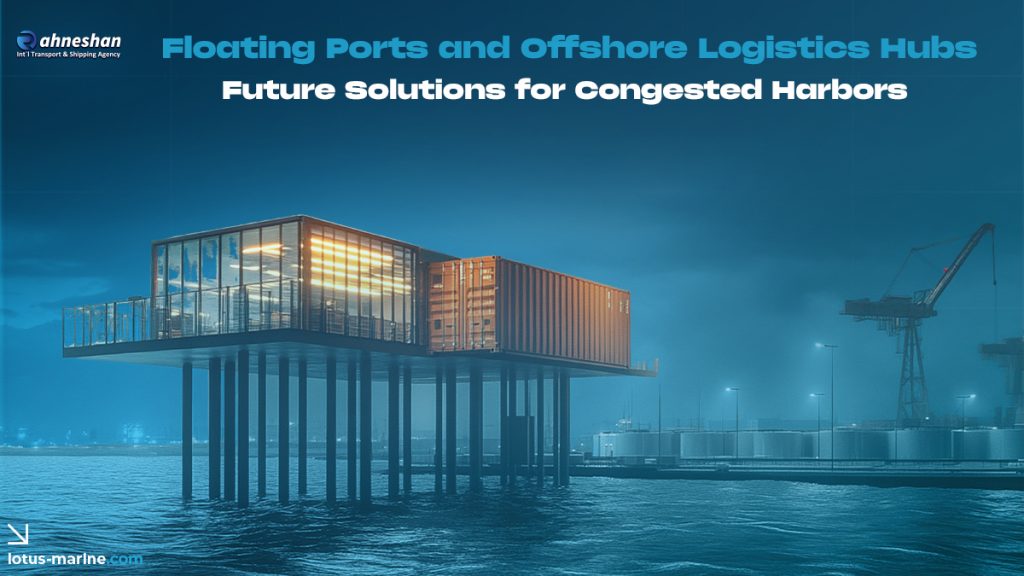
Floating container terminals (FCTs) — These are self-contained, modular platforms built to float on water, designed to function as container terminals or transshipment hubs. They include berthing facilities, container handling infrastructure, and can operate as an extension (or supplement) to traditional ports.
-
Offshore logistics hubs — Beyond container handling, some floating/logistics-hub concepts integrate services such as bunkering, warehousing, transshipment, energy supply, maintenance or intermodal transfers. The flexibility of placement (offshore or near coast) allows them to serve trade lanes without requiring major land reclamation or civil works on shore.
In essence, these platforms act as mobile or semi-permanent extensions of port infrastructure — helping handle overflow, provide alternative docking/transshipment points, and adapt to shifting trade flows more flexibly than fixed ports.
Key Benefits & Why They Matter for Congested Harbors
• Rapid capacity expansion without land constraints
Floating ports bypass the core problem many ports face: lack of land or costly expansion. Since they sit on water, you don’t need large land reclamation or urban redevelopment. This enables quick scaling of port capacity when container traffic surges.
• Flexibility & relocatability — respond to shifting trade flows
Because floating terminals are modular and movable, they can be deployed where needed most: new trade routes, growing markets, or congested hubs elsewhere. This flexibility gives shipping companies and terminal operators the agility to respond to changing demand without long-term infrastructure lock-in.
• Reduced port-congestion and faster vessel turnaround
For ships arriving at crowded ports, floating terminals provide alternative docking/transshipment points. That reduces waiting times, idle anchorage, and berth-slot competition. Faster turnaround improves vessel utilization and reduces opportunity cost tied to delays.
• Cost-effectiveness compared to building new inland/land-based terminals
Building new land terminals or expanding existing ports often involves significant capital, regulatory hurdles, environmental and urban-planning constraints. Floating solutions, being modular and water-based, generally require less shore works — potentially saving cost and permitting time.
• Environmental & sustainability potential (when designed smartly)
Some floating-terminal designs may integrate eco-friendly infrastructure: reduced shore-construction impact, potential energy solutions, and lower environmental footprint compared to large-scale land reclamation or urban port expansion.
Challenges, Limitations & What to Watch Out For
While promising, floating ports and offshore hubs are not a silver bullet. Key challenges include:
• Technical and operational complexity
Designing a robust floating terminal that can safely moor large container ships, handle heavy loads, and operate reliably under varying sea/water conditions requires advanced engineering, structural integrity, and good maintenance practices. Not all maritime regions or coastal geographies may be suitable.
• Dependency on weather and sea conditions
Offshore platforms are exposed to waves, tides, currents, storms — which can affect loading/unloading, safety, and scheduling. That adds a layer of operational risk compared to sheltered land ports.
• Integration with inland logistics & hinterland connectivity
Offshore or floating hubs still need effective connectivity to inland transport networks (road, rail). For a floating port to function well, cargo offloaded offshore must be efficiently transferred to land-based transport. Without good hinterland integration, potential gains may be limited.
• Regulatory, legal and jurisdictional issues
Floating terminals may face regulatory scrutiny: maritime law, environmental regulations, customs & port authority frameworks. Especially in busy or regulated sea-areas, approvals and compliance may pose a barrier.
• Investment and adoption hesitation
Despite potential cost-effectiveness, transitioning from traditional port infrastructure to floating hubs requires stakeholders’ buy-in (shipping lines, terminal operators, local authorities). Risk, uncertainty, and novelty may slow adoption.
What This Means for Freight Forwarders & Shipping Companies (Like Lotus International Shipping)
If you operate in global freight and maritime logistics, floating ports/offshore hubs represent an opportunity to enhance your service offering and adapt to evolving global trade dynamics. Here is how you might leverage them:
-
Alternative port call options: For congested hubs or ports with limited berth availability, route part of your transshipment via floating terminals to reduce waiting time and improve schedule reliability.
-
Flexible routing & cost optimization: Use floating hubs in growth markets or developing regions where shore-based infrastructure lags — enabling entry into new corridors without heavy investment in on-shore infrastructure.
-
Value-added service propositions: Offer clients premium service — e.g. “fast transshipment via offshore hub”, “reduced dwell time in congested ports”, or “entry to less accessible ports” — differentiating your B2B services from traditional carriers.
-
Resilience & scalability: As trade volumes fluctuate, having access to floating hubs provides agility — you don’t depend solely on land-based ports and can scale operations up or down based on demand.
-
Sustainability angle: Promote floating-port option as an environmentally smarter alternative, with potentially lower footprint than building new terrestrial terminals — appealing to environmentally conscious clients and supply-chains.
Outlook & Trends for 2025–2030
-
According to recent industry developments, floating terminal solutions are gaining traction — especially as congestion, land scarcity and port bottlenecks become more pressing globally.
-
As modular design, construction techniques, and offshore-engineering advance, floating ports may become more common — particularly as transshipment hubs or auxiliary terminals rather than full replacements for major seaports.
-
Growing demand for agile, scalable port infrastructure — especially for emerging markets, remote regions or high-volume corridors — will drive adoption. Forwarders and logistics companies that integrate offshore-hub capabilities early may gain competitive advantage.
-
Combined with digital-port technologies (automation, IoT, “smart-port” operations) and advanced logistics planning — floating ports could form part of a larger trend of flexible, resilient, and scalable global maritime infrastructure.
Frequently Asked Questions (FAQ)
Q1. Can floating ports handle large container ships the same way as land ports?
A1. Yes — many floating container-terminal designs are built to accommodate large container vessels. Their modular structure and deep-water access allow handling of heavy loads and standard container operations.
Q2. Are floating ports a replacement for traditional ports?
A2. Not necessarily. Floating ports are better viewed as a complement or supplement — useful in relieving congestion, providing overflow capacity, enabling flexible deployment, and supporting transshipment or hub operations. Full replacement may be unrealistic, especially for major ports with extensive infrastructure.
Q3. What kinds of logistics operations benefit most from offshore hubs?
A3. Transshipment operations, overflow container handling, flexible trade lanes (especially in developing or fast-growing markets), and routes with high port congestion benefit most. Also, when speed, flexibility, or bypassing congested land infrastructure matters — floating hubs deliver value.
Q4. What are the main risks associated with floating ports?
A4. Sea and weather conditions, maintenance requirements, regulatory & legal complexity, and hinterland connectivity constraints are among the major risks. Operational planning, risk mitigation strategies and good infrastructure integration are crucial.
Q5. How should a freight forwarder assess whether to integrate floating-hub options in its network?
A5. Evaluate trade lanes (volume, congestion, port limitations), cost-benefit vs traditional ports, availability of floating-hub infrastructure or providers, hinterland connectivity, and client service expectations (timing, reliability, transshipment needs). If trade flows and volume justify it — floating-hub options can be a differentiator.
Conclusion
As global shipping grows and ports become increasingly congested — especially in land-constrained or high-growth coastal areas — floating ports and offshore logistics hubs emerge as a compelling solution. They combine flexibility, scalability, and lower environmental/land-use impact, offering shipping companies and forwarders a strategic tool to optimize operations, reduce delays, and enter new corridors.